Desk Decor on a Budget: 15 UK-Friendly Ideas to Personalise Your Workspace
A desk with nothing on it is tidy and slightly bleak in equal measure. The gap between a workspace you avoid and one you are happy to sit at is usually small, and rarely expensive: a plant, a lamp, a couple of things that mean something to you. Budget decor has one quiet advantage over the expensive sort — you can change your mind without wincing. Nothing here costs much, so nothing has to stay. Start with what you already own, add one thing at a time, and stop while the surface still works.
Start with a clear surface
Decorating a cluttered desk is like wallpapering a room still full of furniture. Take everything off the top, wipe it down, and put back only what you have used in the past fortnight. Anything you are unsure about goes in a drawer rather than back on the desk. If you have not missed it in a month, it can leave the house.
One tray, one purpose. Pens, clips, a charger and headphones look chaotic loose and tidy the moment they share a shallow tray. Wooden trays turn up in charity shops regularly; a plain ceramic dish or an old enamel plate does the same job. The rule is one tray only, because a second one becomes a second pile.
Tame the cables. This is the least glamorous idea here and the one that makes the biggest difference. Route cables along the back edge of the desk, gather the slack with clips or a fabric sleeve, and label the plugs with scraps of masking tape. Fifteen minutes of work you will appreciate every day.
Give the desk a defined edge. A desk sitting in the middle of a room with no boundaries feels like a table waiting for a meeting. A small rug underneath, a runner along the back, or simply pushing the desk against a wall gives the eye somewhere to stop. It sounds trivial until you sit down and realise the space now reads as yours rather than as something the room happens to contain.
Green things that survive a real desk
A north-facing spare room and a radiator do not suit every houseplant, so choose something forgiving. Devil's ivy, spider plants, snake plants and ZZ plants all cope with lower light and the occasional missed watering, which is more than most of us manage in a busy week.
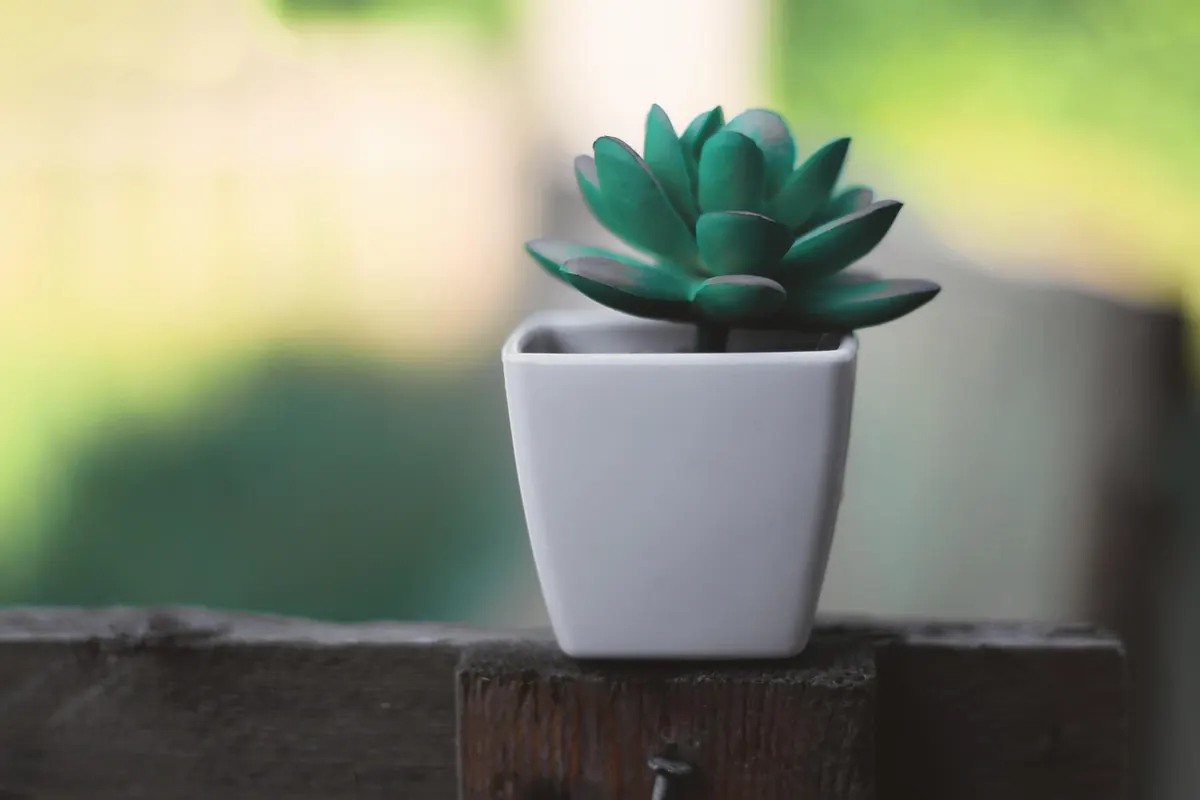
A plant that forgives you. One healthy plant does more for a desk than three struggling ones. Stand the pot on a saucer or coaster — water rings on a wooden desk are permanent, and a stained desk is an expensive mistake.
Dried stems in a bottle. If living things are not your strong point, dried eucalyptus, bunny tails, pampas or simple wheat stems in a clean glass bottle cost very little and last for months. A supermarket bunch left to dry upside down for a week will do; a charity shop bud vase or an empty jam jar stripped of its label works just as well as anything bought new.
Propagate what you already have. A cutting from a friend's ivy or spider plant, rooted in a glass of water on the windowsill, is free and genuinely satisfying. Once it has roots, pot it in a small terracotta pot — the sort sold in garden centres for under a couple of pounds — and you have a plant with a story attached.
Lighting does more than anything else
If you only spend money on one thing, spend it here. Overhead lighting flattens a room and tires your eyes by mid-afternoon; a small lamp at desk level changes the whole feeling of the space. Look for a warm white bulb, around 2700K, and place the lamp so it lights your work without shining into your face.
Second-hand lamps are everywhere. Charity shops, car boot sales and Facebook Marketplace are full of small table lamps for a few pounds. A plain base with an unremarkable shade is easy to improve: a new shade in a colour you like costs less than a coffee and a cake, and instantly makes an old lamp look deliberate.
Fairy lights, sparingly. A short string of warm-white fairy lights wound around a shelf edge or tucked into a clear jar makes a small corner feel considered. Keep it to one string. Two strings is decoration; five is a student flat.
Good desk light is not about brightness. It is about directing the light where you are working and letting the rest of the room stay soft.
Things that mean something
The best desk decor is personal, and personal is almost always cheap. A postcard from a trip, a photograph in a simple clip frame, a ticket stub, a shell, a stone from a beach you like — these say more about you than any matching set from a homeware shop. Rotate them. A desk that never changes becomes invisible.
Frames from the pound shop. Cheap clip frames in a plain finish look far better than their price suggests, especially when grouped in threes with a bit of space between them. Print your own photos at a supermarket kiosk for pennies, or use postcards and gallery flyers instead.
An inspiration board, small and contained. A cork board no bigger than A4, pinned with two or three things at a time, keeps a wall interesting without turning it into clutter. Change what is on it every month or so. Less really is more here.
Something from a charity shop with a past. A brass letter opener, an old wooden ruler, a small ceramic dish, a vintage tin for paperclips. None of it costs much, all of it has more character than the equivalent new item, and much of it comes with a faint smell of someone else's house — which, in a good way, is the whole point.
Small touches that punch above their price
- A decent mug or cup. One that feels good in the hand makes the first ten minutes of work better. Charity shops are full of good stoneware; so are the reduced aisles.
- A small clock or timer. An old wind-up alarm clock or a cheap digital timer gives the desk a focal point and helps you work in blocks rather than drifting.
- A notebook and pen you actually like. A plain notebook with a nice cover, and a pen that writes smoothly, changes how often you reach for them. This is the cheapest upgrade on the list.
- A coaster. Not decor exactly, but a coaster is the difference between a desk that lasts and a desk with a ring burned into it. A tile, a cork mat or a charity shop saucer all work.
- A fabric offcut as a desk runner. A strip of linen, cotton or even an old scarf across the middle of the desk adds colour, protects the surface and takes thirty seconds to change.
Where to shop without spending much
- Charity shops first. Trays, jars, frames, lamps, mugs, tins, old books. Go often rather than with a list; the good things arrive unpredictably.
- Car boot sales and jumble sales. Weekend mornings, cash only, best before nine. This is where the interesting small objects live.
- Supermarket home aisles and discount shops. Fine for trays, storage, notebooks and picture frames. Buy one or two things, not a themed set.
- Facebook Marketplace, Freecycle and local groups. Excellent for lamps and small furniture, and often free if you can collect.
- What you already own. Before buying anything, walk around the house. There is almost certainly a jar, a dish, a plant or a lamp somewhere that would be happier on your desk.
Change it with the seasons
One of the pleasures of cheap decor is that it can follow the year. A few spring daffodils in a jam jar, a bowl of conkers or a small pumpkin in autumn, a sprig of holly or a candle in a tin in December. None of it costs more than a few pounds and all of it makes the desk feel like it belongs to a particular moment rather than to a generic office.
Rotate your objects rather than adding to them. Keep a shoebox somewhere with the things that are not currently out, and swap them over every couple of months. The desk stays familiar and stops going stale at the same time.
Stop before the surface disappears
The failure mode of budget decor is accumulation. It is easy to keep adding because each thing was cheap, until the desk is a shelf for objects and the work has nowhere to happen. Keep a clear rectangle in the middle — roughly the size of a sheet of A4, larger if you use a laptop and notebook together — and treat it as non-negotiable. Everything else has to fit around it.
Then leave it alone for a while. A workspace becomes yours slowly, through use, and the small things you reach for every day will earn their place on the desk far more reliably than anything you buy in one enthusiastic afternoon. Start with what you already own, add one thing at a time, and stop while the surface still works.
Photo: Leamsii / Pixabay